Wednesday, February 25, 2015

Lifted Up


From today's reading:  And just as Moses lifted up the serpent in the wilderness, so must the Son of Man be lifted up, that whoever believes in him may have eternal life.”  John 3:15

I'm sure the disciples were asking, "What is he talking about?"  All the way through - He gave his disciples hints about what was going to happen.  But things were going so well and they didn't want to think about any unpleasantness.  


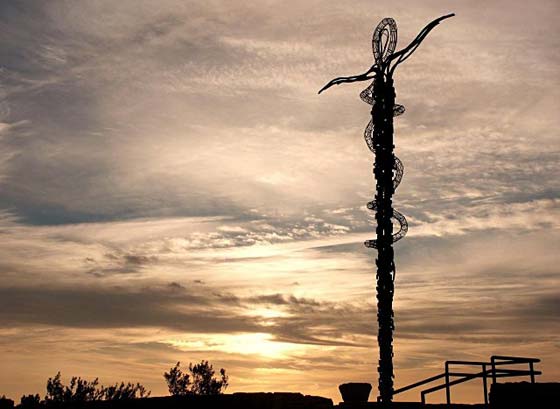
On top of Mount Nebo in Jordan, is a cross made of a serpent on a pole remembering what Moses did in the desert:   "So Moses made a serpent of bronze, and put it upon a pole; and whenever a serpent bit someone, that person would look at the serpent of bronze and live."  Numbers 21:9


In the case of Moses - looking at the serpent on the pole was the cure for those bitten by serpents - they would look upon it and be saved.  In the same way, Jesus is the cure for our sinfulness - anyone looking upon the image of Jesus lifted up on the cross and believing in him will be saved.  As Jesus said to the thief on the cross, "Today you will be with me in paradise."  Jesus says that to each of us -  
 
Like Nicodemus, many of us initially come to Jesus at night - when the world seems darkest, Jesus is the one who can shine light into our darkness - and Jesus is the one who can see us through that darkness and bring us out into the light.  He bids each of us to come - see him and trust him and know that he watches over us.  


Saturday, January 24, 2015

Jesus Calls Us

Now after John was arrested, Jesus came to Galilee, proclaiming the good news of God, and saying, "The time is fulfilled, and the kingdom of God has come near; repent, and believe in the good news.". Mark 1:14-15

Using the words of Jesus, Mark asked his readers to believe Four impossible things. 

Number one - Jesus Christ was the Son of God.  Mark claims that the divine creator of the universe came down from heaven, took human form, and dwelt among us – touching the world in a totally new and profound way.   That Jesus Christ lived, not only 2000 years ago, but he also lives today.

Number two -  He asks you to believe that the time has come – Not a particular day or minute or year – but God’s time – Kairos.  The Kingdom of God is at hand – not in some far distant future – but here, now, on earth, all around us.  And the kingdom of God is found manifest in every person who, for the sake of God, feeds the hungry, clothes the naked, shelters the homeless, visits those who are sick or in prison and comforts those who mourn. 

Number Three   You have to believe is that Jesus is calling you to follow him – in whatever capacity is right for you.  Yes, you have to believe that Jesus wants you – regardless of who you are or what you have done.  He calls each and every one of us, both individually and collectively.  He has chosen each of us:

Number Four - Mark calls you to believe is that if you follow Jesus, you can make a difference in this Kingdom of God on earth.  He asks you to believe, that regardless of who you are, where you’ve been, or what you’ve done…  Regardless of how smart you are or what skills you do or don’t possess, God can and will use you to make a difference to and in the world. 

Are you ready to take up this journey into the unique adventures that God has in store for you?  I say, "Lord, bring it on!"

Wednesday, January 7, 2015

They have no wine

The steward called the bridegroom and said, "Everyone serves the good wine first... but you have kept the good wine until now..."  Jesus did this, his first sign in Cana of Galilee.  John 2:9-11

I love this reading.  I connect with it on a number of levels, but one thing stood out this morning when I read the passage.  Jesus never did anything half-way.  He didn't make just a little wine, but had six stone jars filled - each holding 20 to 30 gallons.  That's a lot of wine - 120-180 gallons of wine,   This party could go on for days.  The other thing was the quality of the wine - it wasn't just wine, it was very good wine.  The steward was appalled that it had been saved for last when people were drunk and couldn't appreciate it.  Jesus shows an extravagance in providing for this couple whose party was about to come to an abrupt end.

Likewise our God is an extravagant God who delights in his creation and in those whom he has made.  He delights in providing for his children and in showing them mercy.  I occasionally thank God for a parking space or a green light and I remember a seminary professor who did not believe in "the God of the parking space."  I don't want to belittle God, or make us seem like puppets where every action is controlled by God.  That's not the way life is.  But occasionally, when something breaks your way, it doesn't hurt to remember that if God clothes the birds of the air (Luke 12:24), then He cares about the details of your life, too. 

Most loving Father, I give you thanks for the small ways you enter into my life.  Help me remember your loving presence in those times when life is tough, when things don't always go right.  The pat on the shoulder, the green light, the sudden awareness of time or place are daily reminders of your love.  Grant us the grace to be a blessing to others so that they, too, may become aware of Your presence in their life.  Amen.   

Tuesday, January 6, 2015

Epiphany - Wise men seek Him

Wise men from the East came to Jerusalem, asking, “Where is the child who has been born king of the Jews? For we observed his star at its rising, ,"  Matthew 2:1-2

Magi - wise men - astronomers - who were these men who came from the East?  And why did they care about this baby born in Judea?  Mystery surrounds this little tidbit of Jesus' life that appears only in the gospel of Matthew.  We don't even know how many there were, scripture doesn't say., only that there were three gifts given.

There is a reason for the saying, "wise men seek him, fools fear him."  And that might be the point of this passage of the gospel.  We are wise when we go out of our way to seek Jesus - for He is the one who can bring peace to our soul, and true meaning to our life.

Because God chose for Jesus to live life as a common man, He understands the trials and tribulations of the common person, the struggles we face every day.  Because Jesus lived as one of us, we can take our problems to Him and He will understand.

The Magi recognized that this child was special and they went out of their way to find him.  We are also called to go out of our way to find Jesus.  In one of my favorite cartoons, Family Circus, Billy is praying in church, he has his eyes closed and is picturing God on his majestic throne in heaven.  The next panel shows Billy kneeling at his bedside picturing Jesus as a baby in the manger, and Billy says, "It's a lot easier to pray to Baby Jesus that to God."  It is okay to see Jesus in whatever form is easiest for us to relate to; for me it's the teacher with dusty feet walking the road, touching the people and listening.

Lord Jesus come, fill our hearts and listen to our ramblings, for you are the one who cares.  Amen.

Sunday, November 30, 2014

You are the potter...

From today's reading:  Yet, O Lord, you are our Father; we are the clay, and you are our potter; we are all the work of your hand.  Isaiah 64:8


Today is the first Sunday in Advent. Our lessons for today are full of apocalyptic images – the heavens torn open, the mountains quake, the sun turning dark, the moon without light, stars falling from the heavens all speak of the end of time.


Yet even amid of these images of destruction, our lesson from Isaiah ends with “you are the potter, we are the clay, the work on your hand.”  This is a reminder that God created us and is intimately involved in our life.  A potter molds and forms each piece, and sometimes he crumbles it up and starts over to remake that which will be good, useful or beautiful.  He glazes it and fires it to make it strong.  God's presence and involvement in our life is the sign of his faithfulness
 

So even though we do things in this life that God disapproves of, he is faithful to guide us back into his presence, and through his son, Jesus Christ we are redeemed, forgiven and restored.  So this Advent, be watchful - keep alert to His presence, and seek opportunities to serve him in this world.
 
Lord, open my eyes that I might see you as you are present in my life and to proclaim your coming to a world in need of your love and mercy.  Amen.


Friday, October 24, 2014

Promises from God

Deut.34:1-12. The Lord showed Moses the whole land...  And said, "'this is the land of which I swore to Abraham,,, I will give it to your descendants'... But you shall not cross over there."

At bible study the other night, one person commented, "that's not very nice, to show him the land but not to let him enter into it."  I would like to argue that it was a very kind thing that the Lord did.  

When Moses began this journey with "the children of Israel," he was 80 years old.  After 40 years of wandering in the desert, he is now 120 years old.  It has not been an easy task of leading this collection of vagabonds.  He has argued with them, he has kept them in check, he has taught them to be a family and given them laws and rules to guide their behavior.  He has judged between them when disputes had divided them. And he has mediated between them and their God.  

As a parent with grown children, I can tell you that it is not easy raising a family and that is exactly what Moses did - for forty years.  (These days we hope our kids are out of the house in 20 years.). Moses is tired and as they approach the promised land, he knows the journey is almost over.  His job was to bring them here.  It will be some else's job to help them become established in the new land.  

As a parent, I can also tell you that more than anything, we want to know that our children are going to survive, that they are going to succeed in life.  We pour our heart and soul into our children and we want to know that they are going to be okay when we are gone.  That is the gift that God gives to Moses:  "you have been a faithful shepherd, doing your best to shape and form these your children.  This is the land they will inherit.  Well done, good and faithful servant."

Moses died there and the children of Israel entered the promised land under the leadership of Joshua.  As a parent, that is all we can do - give our kids the tools they need to live life to its fullest, and trust the Lord to be with them as they continue the journey.  Shalom.

Sunday, October 5, 2014

Being good stewards in the vineyard

Based on readings from Matthew 21:33-46, Exodus 20:1-20, and Philippians 3:4b-14

I want you to think about what it is that you are proudest of in your life.  Is it something tangible?  A new computer or tablet, a new car, your house, your job, your grades in school, your spouse or kids?  Or might it be something subjective?  Your attitudes, or knowledge or a talent or ability, maybe your birthright or status in life or the community?  My husband always claims he’s proudest of his humility.  If you know what you are proud of, I want you to keep that in the back of your mind.


Our first lesson – Exodus 20 – the Ten Commandments is somewhat familiar.  The Ten Commandments were the firsts laws handed down from God on the Holy Mountain.  They can be divided into 2 groups that Jesus so tidily summed up  -  Love God, love your neighbor. 


The first group (commandments 1 – 4) tends to our relationship with God – the vertical.  Our covenant tells us our responsibility to God; we are to love God only; we are not to entertain or idolize other gods; we are not to use his name improperly and we are to spend time with him every week. 


This law about keeping the Sabbath is actually a bridge between the laws describing our relationship with God and our relationship with others.  It’s the beginning of how we are to live our lives here on earth.  We take time to rest – to re-create – to commune (or communicate) with God so that we can begin the new week with renewed vim, vigor and direction.


The rest of the laws have to do with our relationship with each other here on earth.  Honor your mother and father – they were co-creators with God in bringing you to life.  Without them, you would not exist.


You shall not murder, nor commit adultery, nor steal, nor bear false witness, nor covet anything belonging to your neighbor.  (Now I could spend the rest of the sermon elaborating on these commandments – but I’m not.)


Now, I admit that I have made fun of those 6 hundred 15 laws that a righteous Jew was supposed to follow.  When you think about it, a lot of those laws dealt with the same kinds of things that today’s laws deal with.  Would anyone here like to give a guess about how many laws there are in America today?  There are whole libraries dedicated to stating and explaining the laws that have been passed by the national and state legislatures.  The reason we have to have laws is because there are always people who are going to do things that end up hurting others – and without laws there would be chaos and anarchy. 


In a perfect world everyone would be kind and courteous to everyone else and we would need no laws.  Problem is we don’t live in a perfect world.  When I taught school, we usually ended up the year with many more rules than we started with – because each time a student would do something (that we had not anticipated) that injured someone or caused some kind of trouble or disruption, a new rule would have to be made.


At the first of this sermon, I asked you what kinds of things you were most proud of.  In our second lesson we hear Paul talking about the things he is most proud of…  He's proud for being a born and bred, card carrying, law-abiding Jew, righteous under the law – he makes a long list of all the things that as a Jew he has a right to be proud of.  Many of these qualities set him apart from the crowd and in Jewish circles placed him above the average person.


But Paul, following his conversion, has come to realize that it doesn’t mean anything.   He now understands that in the grand scheme of things, at the end of his life, it is not going to matter.  Paul has learned that it is the love of Christ that is of utmost importance and he declares that he doesn’t want the kind of righteousness that comes from pride and the law – but only that which comes from faith in Christ. 


And then we come to Jesus – and to one of those parables that is somewhat discomforting – an allegory that challenges us. 


I read a number of sermons expounding on how this parable makes sense to the people of that day – but it goes deeper than to say “oh, there were lots of absentee landlords in Israel at the time of Jesus...” The Hebrew people had a collective memory of their history and their scriptures.    In a way of explanation let me offer the following: 


If I were to begin, “Jesus love me, this I know,___”

How about “Holy, holy, holy. ______”

And “Amazing grace,  _________”

You folks know these – you’ve sung them over and over – now you have three tunes rolling around in your head.  That’s the same way the Jews were with the Psalms – they knew them because that was their hymn book, songs they sang over and over. *


Likewise you know many of the Old Testament Bible stories – as the first lesson was read, you might have thought of Charlton Heston standing on the mountain holding the tablets of the commandments.  If I were to mention, “the Garden of Eden” or  “Noah’s Ark,” you know what that is about – and an image probably comes to mind.   If I say, “Joseph and the many colored coat,” you know it – an image comes up - or David and Goliath.  Likewise this parable Jesus tells begins as a familiar story from scriptures. 


For the people Jesus was talking to (the chief priests and the elders and Pharisees), the image of a vineyard was that kind of thing – It‘s from Isaiah 5, and I’m going to quote it for you.  “Let me sing for my beloved my love song concerning his vineyard:  My beloved had a vineyard on a very fertile hill.  He dug it and cleared it of stones and planted it with choice vines; he built a watchtower in the midst of it and hewed out a wine vat in it; he expected it to yield grapes, but it yielded wild grapes.”


This sounds very much like the parable we just read from Matthew.  It is a story about God – and the land he had provided for his people – with everything they needed for life – and the people are the grapes – not the good grapes God expected but wild (sour) grapes.  It was a song of the unfaithfulness of the people of God.


Now when Jesus tells this parable, it is not the produce itself that is found wanting, but those who have been given responsibility to tend the vineyard (the leaders).


The thing we find interesting as we examine this parable is the patience of God.  He sends his slaves to collect the portion of the harvest that belongs to him.  When the tenants beat one, stone one and kill one, the landowner doesn’t immediately rush in and punish the tenants.  He sends more slaves to collect the tithe owed to him, and the tenants treat them the same as they had the first. 


So the landowner sends his son, the heir to the property.  And the tenants seem to think they can kill him and then the property will be theirs.  Because they have worked the field and harvested the grapes, they have decided they are entitled to the entire harvest, forgetting that it was the owner who cleared the land, planted the fields and built the fence, press and tower.  We see the patience on the part of the landowner, for he is willing to give the tenants a chance to do the right thing – not just one chance, but multiple chances.  Notice that Jesus leaves the parable there – he does not complete it.  He poses the question, allowing the religious leaders to draw their own conclusions  -  and they do – out of their own flawed reasoning.   


Today is the beginning of our stewardship season, and this is a story about stewardship.  How well do we tend this corner of the garden that God has given us? As new tenants of the vineyard it means we are the ones responsible for producing new fruit and presenting it to God.  How are we going to be different from the original tenants?  It is now our turn to give back to God from what he has given to us. 


This says so much more about the way we are to live our lives and conduct our affairs. How do we tend our vineyard?  God created this wonderful place for us to live and he filled it with all good things – all the things that combined with the knowledge and wisdom and willingness to work – can be used to provide us with a really good life.  Are we careful with the things that God has given us?  Do we tend this vineyard and take care of those things which God has provided for us?  Do we give credit to God for those things which make our life worth living? 


So what kinds of stewards are we of those things that God has given to us.  Do we give back to him from the first fruits of our bounty?  Do we honor that which God has given us?  That’s a question that each one of us has to answer for ourselves. 


There was a time when Sam and I were “C and E’ers” – we only attended on Christmas and Easter – if we happened to be in
Alvin on those holidays.  God began working on each of us individually and eventually we moved back to Alvin and began going to church on a regular basis – every Wednesday night to choir practice and every Sunday to church.  And I have to say it was more about singing in the choir and making music than it was about worshiping God.   


I’d like to be able to say that there was some moment of enlightenment or inspiration that was the beginning of the change in me – but I don’t recall any.  I just know that somewhere along the way of faithful attendance, I quit watching the clock and started listening (really listening) to the sermons.  I started hearing things that rang true, that made sense, that inspired my imagination. 


And the first time they talked to us about filling out a pledge card, my reaction wasn’t really that great.  That was my hard earned money and we had a family to feed.  The first time I really remember Sam and I sitting down and talking about any real kind of “donation” was at a marriage encounter weekend.  It was a powerful experience of the love of God shone to us through other loving couples.  There was no upfront cost for the weekend, but one of the talks dealt with giving.  As Sam and I wrote about this separately and later talked about it, we both decided that we wanted to give – not only to cover our own costs, but also to cover the cost for another couple to attend.  Over the years I did work up to a tithe, but it didn't happen overnight.
 

As I've grown in the Lord, I have come to realize that God has indeed always given me the things I needed – he has found amazing ways to take care of me.  And I have found that if I return to him out of the bounty he has provided, he manages to do wonderful things with what I provide, regardless of size.   What we give to God should always be our response for the faithfulness of God to provide for us.  And what I have learned is that God’s faithfulness always trumps my own meager efforts.  Amen. 
 
 
* From a sermon by Randy L Quinn